Apple Made Mac Clustering Real Last Spring. The Cheap Mac mini Still Can't Join In
Clustering Macs for local AI works today, no leaked Apple app needed. But the $899 Mac mini has the wrong ports, and the real entry price is $3,467.
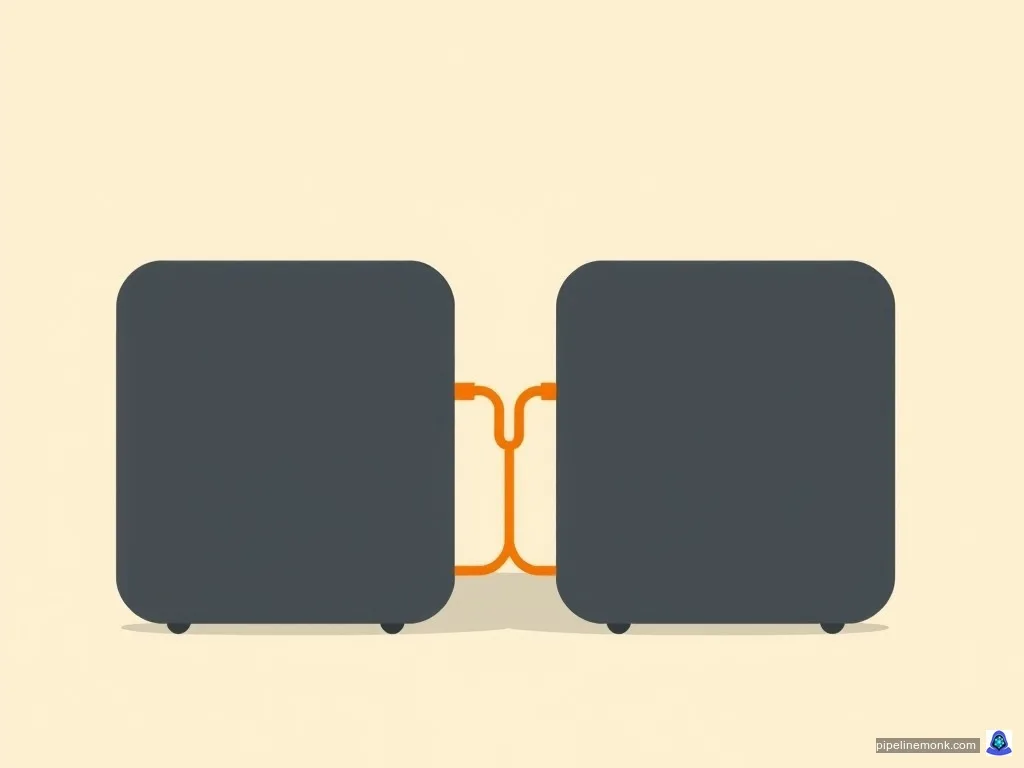
On 10 November, 9to5Mac reported that leaker Aaron Perris had turned up an unreleased Apple app called Harbor, in private preview under Apple’s Claris brand. The description Perris posted says it turns a Mac into a private inference server, and that you can “connect two or more Thunderbolt 5-capable Mac computers” and have it pool their unified memory into one resource. Apple has not commented and there is no ship date, so treat that as a leak, not a product. But it points at something that is not speculative at all: you can run an LLM across two Macs today, with software that already exists, on an operating-system feature Apple shipped back in the spring.
What the Harbor coverage leaves out is the part that decides whether any of this is for you. The cheapest Mac mini Apple sells cannot do it — not “does it slowly”, cannot, because it has the wrong ports. The real entry ticket is $3,467, and it buys considerably less pooled memory than the headline specs suggest.
I should say up front that I have one Mac and no cluster. What follows is Apple’s documentation, the projects’ own, and one independent test by someone who bought four Mac Studios — and every number below names whoever measured it.
What Apple actually shipped, and when
The thing that makes a Mac cluster interesting is RDMA — Remote Direct Memory Access — over Thunderbolt. In Apple’s words, in technote TN3205, it “exposes an RDMA (Remote Direct Memory Access) Verbs compatible API for the Thunderbolt controller which enables carefully designed software to operate at the hardware limits of Thunderbolt.” In plainer terms, one Mac writes into another Mac’s memory without dragging the data up through a networking stack on both ends — which matters, because splitting a model across machines means moving activations between them constantly.
Apple’s technote says RDMA over Thunderbolt is available starting with macOS 26.2 on Apple silicon Macs with Thunderbolt 5. It was first published on 19 March 2026 and last revised on 13 April 2026, so the official procedure has not changed since spring, whatever has happened to the Mac line since.
How much it helps: Jeff Geerling, testing a four-machine cluster, measured memory access latency dropping from 300μs to under 50μs once RDMA was on. Apple’s own marketing claim, from its September newsroom post and based on Apple’s own testing in July 2026, is that clustering Mac Studios gives “up to 3x faster performance for distributed AI inference when compared to a single system.” That is Apple describing Apple’s hardware; the independent numbers further down are less flattering.
The $899 Mac mini can’t do this
Here is the fact that reframes the whole exercise.
Apple’s September 2026 refresh put the Mac mini with M6 at $899 and the Mac mini with M5 Pro at $1,699. Mac Studio with M5 Max starts at $2,499 and M5 Ultra at $5,499.

Now check the ports. Apple’s tech specs page for the current Mac mini lists “Three Thunderbolt 4 (USB-C) ports” on the M6 model and “Three Thunderbolt 5 (USB-C) ports” on the M5 Pro. RDMA requires Thunderbolt 5. So the $899 machine, the one that makes this sound like a cheap experiment, is out before you start. The cheapest Mac that can legitimately join an RDMA cluster is the $1,699 Mac mini with M5 Pro.
Two of those is $3,398. Add Apple’s Thunderbolt 5 Pro cable at $69 and the entry ticket is $3,467 — and read what that buys carefully, because this is where the sums people post online quietly go wrong. Apple’s specs page says the M5 Pro Mac mini ships with 24GB of unified memory, configurable to 48GB or 64GB. At $1,699 each you are pooling 24GB and 24GB: that is 48GB across two machines, not the 128GB the “up to 64GB” headline implies. Reaching 128GB means buying the 64GB upgrade twice, and Apple publishes no price for it on either page — so price that configuration on Apple’s store before you budget anything.
The cabling then gets worse than linear. Apple’s technote spells it out: two Macs need one cable, three need three, four need six, because every machine must wire directly to every other.

At Apple’s price that is $414 of cable for a four-node cluster, on top of the Macs. There are no Thunderbolt 5 switches to simplify it — Geerling notes he had to run a full mesh for exactly that reason.
If you are now thinking about the Thunderbolt 4 machine you already own: there is a project for that, and it is honest about what it costs you. Zhaofeng Li’s tb4-rdma-enabler states that “Apple only officially supports RDMA over Thunderbolt 5” and that the Thunderbolt 4 controller physically has the capability but it “is intentionally disabled in AppleThunderboltRDMA.kext.” It re-enables it at 40Gbps by installing a kext, and it was tested on macOS 27.2. It also carries its own warning in bold: “This is unsupported and will weaken the security of your system!” Getting it running means disabling kext signing and dropping the machine to a lower security mode. That is a real trade, not a formality.
The three ways to run an LLM across two Macs today
MLX distributed is Apple’s own framework, and its documentation lists four communication backends. RING runs “over TCP sockets” and is “always available and usually faster than MPI.” JACCL is the RDMA one — “low latency communication with RDMA over thunderbolt. Necessary for things like tensor parallelism.” MPI is the mature general-purpose option and NCCL is for CUDA, so neither matters here. The catch, from the same docs: “The JACCL backend supports only fully connected topologies,” which is where the six-cables-for-four-Macs arithmetic comes from.
exo is the one most people actually run. It is Apache-2.0, and its README advertises “day-0 support” for RDMA over Thunderbolt 5, requiring macOS Tahoe 26.2 or later. Its own published figures are “up to 1.8x speedup on 2 devices and 3.2x speedup on 4 devices” for tensor parallelism, plus a “99% reduction in latency between devices” — exo’s numbers about exo, so weigh them accordingly. The README is unusually frank about conditions: every device must connect to every other, cables must support Thunderbolt 5, and OS versions must match exactly. Mixing exo versions in one cluster “isn’t supported.”
llama.cpp’s RPC backend is the one that works on anything, over ordinary TCP, with no RDMA. You build with -DGGML_RPC=ON, start bin/ggml-rpc-server on each remote machine, and point the main host at them: llama-cli -hf <model> -ngl 99 --rpc 192.168.88.10:50052,192.168.88.11:50052. Weights and KV cache get split across local and remote devices in proportion to available memory unless you override it with --tensor-split. It is the most flexible option, and the one to be careful with.
If your actual problem is a single model that won’t fit, it is worth checking whether one machine can be made to hold it with aggressive offloading before you buy a second machine at all.
Turning it on: what the procedure really is
RDMA is not on by default, and switching it on is more involved than a settings toggle. Apple’s documented procedure is four steps plus a check:
- Reboot into macOS Recovery.
- Open Terminal from Utilities.
- Run
rdma_ctl enable. - Reboot back into macOS.
- Confirm the interfaces exist with
ibv_devices.
On a working cluster each interface reports PORT_ACTIVE once every connected Mac has RDMA enabled. Note the implication of step 1: MLX’s documentation states flatly that this “cannot be done remotely even with sudo.” You need to be physically at every machine in the cluster. For a stack of headless Mac minis in a cupboard, that is a genuine inconvenience every time you rebuild one.
Apple’s technote then lists the configuration people skip and later blame on the software. Disable the Thunderbolt Bridge if you are cabling machines in loops — the default setup bridges all Thunderbolt ports into one network, and in a loop that means frames “can then travel indefinitely, consuming excessive CPU time and compromising network performance.” Disable idle sleep, because “Thunderbolt does not support Wake-on-LAN” and a sleeping node simply vanishes. Turn on automatic login and “start up automatically after a power failure” if you ever want the cluster to come back by itself.
That procedure is transcribed from Apple’s technote rather than run here, and the technote has not been revised since April — so if a newer macOS has a shortcut, Apple has not documented it.
Never put the llama.cpp RPC server on your network
This one deserves its own section because the warning is easy to scroll past and the consequence is not.

llama.cpp’s own documentation says the RPC backend is “currently in a proof-of-concept development stage. As such, the functionality is fragile and insecure. Never run the RPC server on an open network or in a sensitive environment!” There is no authentication described anywhere in it. ggml-rpc-server exists to accept work from another machine and run it, and nothing in it establishes who is asking.
On a home network that is shared with a smart TV, a guest phone and whatever a housemate installed, “open network” is not a distant abstraction. Bind it to the Thunderbolt link or a dedicated interface, not to everything.
exo is better but not immaculate. Its README describes an API on localhost:52415 with no authentication, and an optional Thunderbolt setup that takes an administrator password and installs a system service, io.exo.networksetup, running at startup and roughly every 30 minutes. That is reasonable for what it does, but it is a persistent root-level service and you should know you installed one.
What the numbers look like when someone actually measured
The only serious independent four-node test is Jeff Geerling’s, published 18 December 2025 on prerelease exo 1.0 and macOS 26.2. That is nearly a year old and the hardware — four M3 Ultra Mac Studios, two with 512GB at $11,699 each and two with 256GB at $8,099 each — is no longer what Apple sells, so read the shape rather than the exact figures.
The shape is sobering. On HPL, one M3 Ultra managed 1.3 TFLOPS; all four together managed 3.7, which Geerling calls “less than a 3x speedup” for four times the hardware. Thunderbolt 5 delivered roughly 50-60 Gbps of real throughput against its 120Gb/s headline. Qwen3 235B ran at up to 32 tokens per second across the full cluster, and Kimi K2 Thinking — around a trillion parameters, 32B active — held “around 30 tokens per second.” Idle draw for the whole stack was under 10 watts, the one number that flatters Apple silicon unreservedly.
He hit the failure modes too. HPL over Thunderbolt with plain TCP and no RDMA made both configured Macs “crash and reboot” after about a minute. exo sometimes failed to load models outright. And system upgrades could not be done over SSH, so every node needed hands on it again.
The honest reading of all this: clustering buys you capacity, not speed. Four machines let you load a model that one machine cannot hold. They do not make that model four times faster, or even three.
Where this falls over
Apple’s own documented limits on RDMA over Thunderbolt are tighter than the marketing suggests. It supports send and receive operations only, a maximum of 10 unreliable-connection queue pairs, messages up to 16,773,120 bytes, and 4,095 work requests at a time. Most significantly, there is no hardware acknowledgement: Apple’s technote states that completion of a send “does not indicate the receiver has successfully received the sent data or that data was not corrupted in flight because Thunderbolt does not perform Acks in hardware.” Reliability is the application’s problem — which is why “carefully designed software” is doing real work in Apple’s own description.
Past four machines the topology stops being a mesh. Apple’s five-node example is a ring, where “the application is responsible for forwarding data” — Mac 4 cannot reach Mac 1 without Mac 2 relaying.
Then there is the operational tax, which compounds: exo needs matching OS and exo versions on every machine, so one node auto-updating takes the cluster down. None of this is a bug; it is what a cluster is.
Should you buy the second Mac?
For most people reading this, no — and the comparison is less flattering than the cluster’s fans make it sound.
$3,467 of Mac minis gets you 48GB of pooled memory across two machines, at a measured speedup under 3x, with Recovery-mode surgery on both, version-matching forever, a second power draw and a cable between them. A single Mac Studio with M5 Max starts at $2,499 and ships with 36GB in one box, with four Thunderbolt 5 ports and none of the operational tax. That is $968 less for 12GB less memory, in a machine that configures up to 128GB on its own.
Which wins at equal capacity cannot be settled from Apple’s published pages, since it prices neither upgrade. Anyone telling you a two-Mac cluster is the cheap route to 128GB is quoting a configuration they have not priced. Configure the single Mac Studio on Apple’s store and compare it against two configured minis plus cable — and note that only one of those options also charges you in Recovery reboots and version lockstep.
Clustering earns its place in one situation: the model does not fit in any single machine you can buy. That window is narrow, because a Mac Studio with M5 Ultra reaches 512GB of unified memory at 1.2TB/s. Past half a terabyte of weights you are not making a consumer purchasing decision anyway. If you are chasing lower cost per token rather than a bigger model, the self-hosting cost math deserves running first — it rarely favours more hardware.
Two things would change the answer. One is Harbor shipping and being good, since most of the pain above is setup pain that an Apple-quality app could genuinely absorb — though an unconfirmed leak with no ship date is not something to buy hardware against. The other is a Thunderbolt 5 Mac at the bottom of the range. The moment an $899 Mac mini has Thunderbolt 5 ports, the entry price for a two-node cluster drops to about $1,867 and this becomes a reasonable weekend project instead of a $3,467 one.
Until then, if you have never run a model locally at all, start with a single machine and Ollama and find out what you actually need before buying a second computer — or try the local file search tools that run on the Mac you already own, which cost nothing to test tonight.
Sources
Every figure in this article traces to one of these. Dates are when the page was read.
- TN3205: Low-latency communication with RDMA over ThunderboltApple DeveloperAccessed Nov 13, 2026Official docs
- The new Mac mini and Mac Studio are available todayApple NewsroomAccessed Nov 13, 2026Vendor pricing
- Mac mini (M6 or M5 Pro) — Tech SpecsApple SupportAccessed Nov 13, 2026Official docs
- Mac mini — Technical SpecificationsAppleAccessed Nov 13, 2026Official docs
- Mac Studio — Technical SpecificationsAppleAccessed Nov 13, 2026Official docs
- Distributed Communication — MLX documentationApple / ml-exploreAccessed Nov 13, 2026Official docs
- llama.cpp — tools/rpc (RPC backend README)ggml-org/llama.cppAccessed Nov 13, 2026Official docs
- exo-explore/exoexo labsAccessed Nov 13, 2026Official docs
- 1.5 TB of VRAM on Mac Studio — RDMA over Thunderbolt 5Jeff GeerlingAccessed Nov 13, 2026Independent
- Thunderbolt 5 (USB‑C) Pro Cable (1 m)AppleAccessed Nov 13, 2026Vendor pricing
- zhaofengli/tb4-rdma-enabler — Enable RDMA on Thunderbolt 4 MacsZhaofeng LiAccessed Nov 13, 2026Independent
- Apple has new Mac app coming to make running local AI models easy9to5MacAccessed Nov 13, 2026Independent
Written by

Full-stack developer who builds and runs AI automation systems in production. Runs local LLMs on personal hardware, builds N8N pipelines that actually ship, and deploys on Cloudflare Pages. Every guide on Pipeline Monk is tested on real consumer hardware — a Ryzen 7 5800HS with 16GB RAM and a GTX 1650. If it works on that, it works.